
Bilofix Revisited
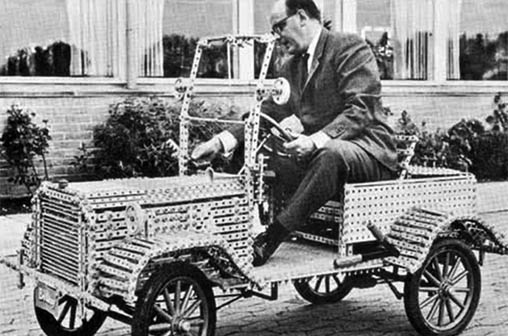
Gerhardt poses on a rather large display model, 1967
For a complete review of the system see Steve Scott’s aptly named Bilofix.com.
1. The Bilo and Bilofix trademarks were registered and maintained by Interlego AG. It appears that they were either licensed or given to Gerhardt.
After leaving Lego the previous year, Gerhardt moved to the nearby town of Kolding, built a 3250 m2 wood products factory, and began his own (suprise!) toy company.
For his new business Gerhard took the wood and plastic Bilofix Ingeniørsæts that he had developed in 1959, as well as the name Bilofix.1
His intention was to develop the wood and plastic sets into a complete construction system. The idea, from a 1967 interview was:
2. “Ein Baukasten verschlingt ganze Wälder” Leben und Erziehen Nov 1967. “... to make technology understandable for our children in a natural way. It shouldn’t be bound to an age and there should be nothing they couldn't build with these elements. On the other hand, every part had to fit so that the box of building blocks could be extended anytime. And in particular I wanted to make nothing complicated, or confusing; but something that is straight forward and logical. Learn to play - play with a system - this was the idea.” 2
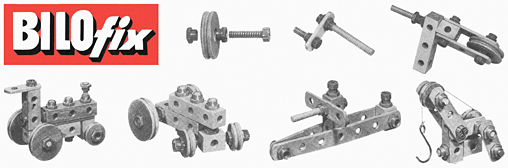
A mosaic of Bilofix ideas, from the Set no.3 inner box
3. The early Bilofix plastic elements were the same quality as Lego elements, not suprising since they were molded with the same ABS used for Lego bricks. The wood parts were also very well milled and finished ― almost furniture quality. The wooden elements were milled by Bilofix in Kolding, but it appears that, at least initially, the plastic elements were molded by Lego in Billund using the original 1959 molds. Later, as Gerhardt introduced new plastic elements, the molding was transferred entirely to Kolding.3
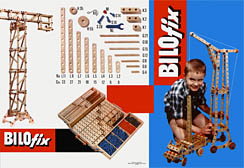
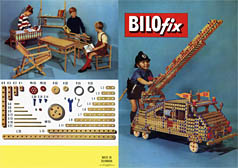
Danish Bilofix catalog, 1963 and German Bilofix catalog, 1966
Gerhardt marketed Bilofix very much like Lego; the original assortment included several basic sets and a number of small supplementary sets. Over time the range was expanded to include more basic sets, including several large wooden box sets, such as the No. 12 Golden Box and the massive no. 15 Master Building Box, as well as many new supplementary sets, including wheel sets, cog wheels, worm gears, even an electric motor.
Expansion
The toy was first noticed in educational circles and soon sales began to grow. In 1964 Gerhardt expanded the Kolding factory. At its peak in the mid-1960’s the factory was producing 40,000 blocks and 150,000 beams a day on six automated machines and was processing 10,000 birch trees a year.
4. Although some US toy stores, such as FAO Schwartz, directly imported the toy from Kolding:
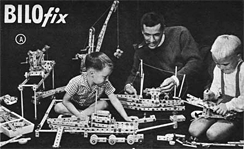 Initially Gerhardt sold the toy in Scandinavia and later it was distributed or licensed in most of Western Europe, Canada, Japan and the UK, but it was never distributed in the US.4
In October 1965 the toy won the Meilleur Jouet Award in France. This was followed by the Jeppe award in Denmark and later by awards in Germany, Japan and Canada.
Initially Gerhardt sold the toy in Scandinavia and later it was distributed or licensed in most of Western Europe, Canada, Japan and the UK, but it was never distributed in the US.4
In October 1965 the toy won the Meilleur Jouet Award in France. This was followed by the Jeppe award in Denmark and later by awards in Germany, Japan and Canada.
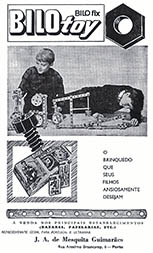
Bilotoy, Bilotec and Hanse Tec
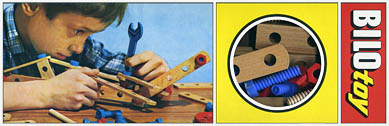
Set no.33, 1969
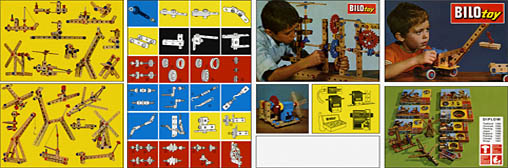
Danish Bilotoy catalog, 1969
In 1969 Gerhardt signed an agreement with Revell Plastics GmbH and they became the exclusive European distributor. Revell sold the system under the name Bilotoy and even expanded the assortment to include wooden preschool toys (Bilo earlyplay). In 1972, however, Revell dropped the toy stating that “high price increases from the Danish manufacturer...would not be acceptable to the German market.” Around that same time Gerhardt sold the company, including the molds and inventory, to the Danish toy distrbutor K.E. Mathiasen A/S. Mathiasen, along with the Japanese distributor Bornelund, manufactured and marketed the toy under the name Bilotec and later as Hanse-Tec.