
Billund Maskinsnedkeri og Tømreforretning
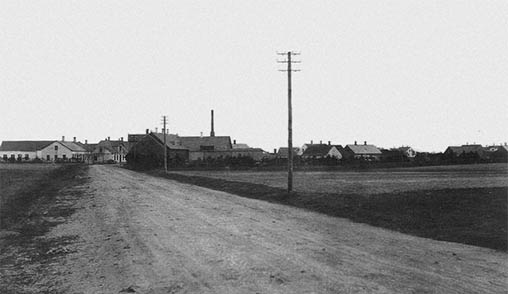
Billund, ca.1916
Ole Kirk Christiansen was born 7 Apr 1891 in the village of Filskov, located between the towns of Sonder Omme and Give in Central Jutland. He was one of 10 children of Jens Niels Christiansen and Kirstine (Andersen) Christiansen.
The phrase “the middle of nowhere” is probably a cliché, but if it applies anywhere it might very well be Central Jutland in the late 1800’s; a region of flat terrain, heather-covered moors (hede), peat bogs (mose), and sandy dunes (sande).1 1. Today, with the abundance of high-resolution satellite maps, there really isn’t a “middle of nowhere” anymore. Try this, for example. For more information about Danish mapping, because I know you are interested, see this. For more than two centuries the Danes have tried, with varying amounts of success, to cultivate the regions’ sandy soil, and by the turn of the century the area was primarily pasture for herds of horses, cattle and sheep, as well as hog and dairy farming.
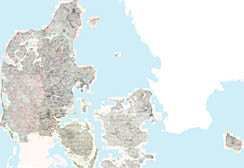
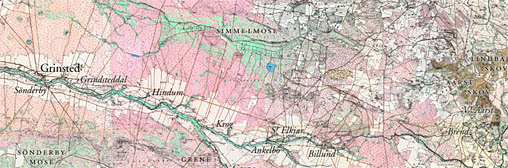
The Kingdom of Denmark and Central Jutland detail from early ordinance maps
Jens owned a small farm (a “smallholder” in Danish terms), but it was not enough to provide for his large family; he also had to work as a laborer on the surrounding farms. By all accounts the family grew up in hardship and poverty. The Christiansen children were all expected to help with the farm chores as soon as possible and in one often repeated example Ole was sent out at age six to watch sheep on the moors.
Ole spent two days a week in a local school learning to read and write and would spent the rest of the time working on the farm. At most he would receive the equivalent of a grade school education. He followed the path of most poor rural boys and learned a trade. After his Lutheren confirmation at the age of 14 he was apprenticed to an older brother, Kristian Bonde Christiansen, to learn carpentry and joinery. He spent the next four years studying under his brother and was awarded his journeyman’s certificate on 24 Aug 1911.
Having completed his apprenticeship, and realizing that there was no real work to be had in Filskov, he left to seek his fortunes abroad. He worked in Germany from 1911–1912 and Norway from 1912–1916.
Billund
Ole returned to Billund, Denmark, just 30 km southeast of his birthplace in Filskov, in 1916 and married Kirstine Sörensen, from nearby Lind Balle. Ole used his savings to purchase the Billund Maskinsnedkeri og Tømreforretning (The Billund Carpentry Shop and Lumberyard), which had been established by Steffen Pedersen in 1895.
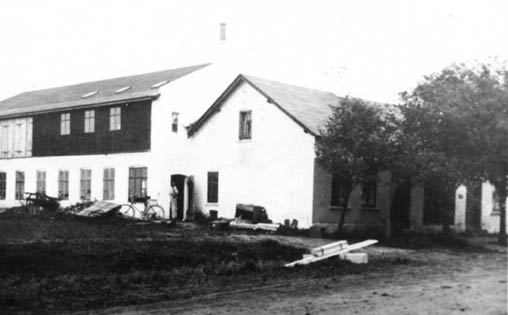
The workshop and family house, ca.1924
Life in Billund was much like that in Filskov 20 years earlier. At the time the village was really nothing more than several buildings clustered around the road, and later the railway, between Vejle and Grindsted.2 2. Billund received it‘s first telephone in 1902. The railway station was built in 1914 (and closed in 1957) and the first electric generator was built in 1917. By 1930 the official population was 1,046 and enrollment in the local school was 86. One writer described the village in the early 1920’s as “A God-forsaken railway stopping-point where nothing could possibly thrive.” Life was difficult for the farmers and, perhaps, even more so for the tradesman and craftsman who supported them.
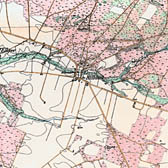
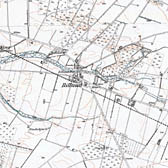
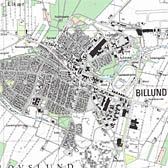
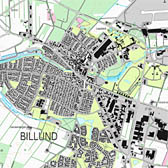
The growth of Billund, 1870–2003
3. Here is the 1921 Grene parish census record: Ole Kirk Kristiansen, 7 Jul 1891, Filskov, husband, carpenter; Kristine Kristiansen, 1 Feb 1892, Lind Balle, housewife; Johannes Kristiansen, 6 May 1917; Karl Georg Kristiansen, 17 May 1919; Gotfred Kristiansen, 8 Jul 1920. Note the spelling. The 1925 census has yet different spellings Ole and Kirstine quickly started their own family: Johannes was born in 1917, Karl Georg in 1919, Godtfred on 8 July 1920 and Gerhardt in 1926.3
Ole would spend the spring and summer working on any construction or home repair jobs he could find. In the winter he would make furniture and stock up on doors and windows. He started with small jobs and, as the community slowly began to grow and his reputation for honest, quality work spread, he began to be awarded larger projects. An early commission around 1918 for a church hall in Almstok was followed by diaries in Billund and Randbøl and a church in Skjoldborg. But throughout the 1920’s Ole’s business was a struggle. Even in the best of times the regions’ farmers were cash-strapped and Ole was often on the verge of bankruptcy.
The First Fire
In 1924. On a Sunday afternoon, while Ole and Kirstine were napping, Karl Georg (then 5 years old) and Godtfred (4) were playing in the shop and set fire to some wood shavings with a glue smelter. The shop and the house house burned to the ground. Undaunted, Ole had an architect draw up plans and built a new, larger building. The new building was much larger than he could afford so Ole and his family lived in a single apartment next to the shop in the back and rented the other rooms out. The building, which would be known for its large dormer and two lions flanking the front door, is now part of the Lego Group and is one of only a few of Ole’s buildings that still exist.
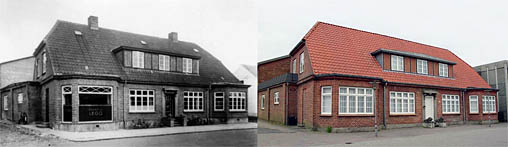
The house and workshop, 1935 and 2005
Indre Mission
What carried Ole though these difficult circumstances was his faith in God. The Kirk Christiansen family were devout
followers of Indre Mission,4
4. The Kirkelig Forening for den Indre Mission i Danmark (The Church Association for the Inner Mission in Denmark), or simply Indre Mission, is a conservative, orthodox,
fundamentalist movement of the Danish national Lutheran church. Founded on 13 Sept 1861 in Stenlille, Zealand, it became influential in rural Denmark. Ole, and later Godtfred, as well as much of their Billund workforce, were devout followers of the movement. During the 1950’s Ole even lead morning prayer sessions at the factory.
4. Hansen, Willy Horn. 50 Years of Play. Trans. Charles Napier. Billund: Lego System A/S, 1982.
a fundamentalist offshoot of the Danish Lutheran Church. As Godtfred recounted in a 1982 interview:
“I am convinced that father’s faith in God, which was evident in everything he did, helped carry him through his grief and the difficulties that followed... His faith made him a active man. It gave him the courage and solace that enabled him to take on new responsibilities - and the strength to see a job through despite hardship.”4
It was the combination of the hardships of farm life and his devout religious faith that would help shape Ole’s character, all of which was best summarized by Ole himself in his most famous quote:
“Life is a gift, but it’s more than just that. Life is a challenge.”